
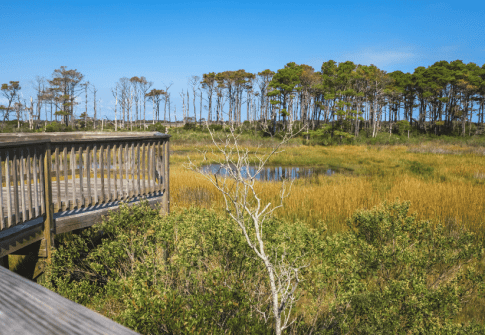
As Maryland prepares to mark 250 years since the founding of the nation, Maryland’s Coast offers a way to experience that history beyond exhibits and timelines. In Worcester County, history unfolds outdoors along rivers, through shaded forests, across barrier islands, and within walkable towns that still reflect the past.
Maryland 250 invites residents and visitors alike to explore where history happened. On Maryland’s Coast, that invitation feels especially fitting in spring, when longer days and milder weather draw people outside to reconnect with the landscapes that have shaped life here for generations.
Whether you are planning a day trip, a spring weekend, or a longer stay, Worcester County offers a chance to experience history at a pace that feels personal and unhurried.
Miles for Maryland: Turning History Into Movement
Worcester County is home to Maryland State Parks that provide direct access to the landscapes shaping Maryland’s Coast. These protected areas offer forests, barrier islands, and river corridors that supported early settlement, industry, and everyday life on the Lower Shore.
At Assateague Island National Seashore, designated walking trails wind through dunes and maritime forests, where shifting sands, salt air, and open skies tell a long story of adaptation and resilience.
At Pocomoke River State Park, including the Shad Landing and Milburn Landing areas, forested trail systems follow the Pocomoke River corridor. These quiet paths reflect the region’s historic relationship with timber, waterways, and communities that once relied on the river for trade and travel.
Together, these state park landscapes provide natural places to slow down, stretch your legs, and experience Maryland’s history in the environments where it unfolded.
As part of the Maryland 250 commemoration, Maryland State Parks has introduced the Miles for Maryland Trail Challenge. Participants are invited to hike 250 miles on designated trails within Maryland State Parks throughout the calendar year.
Worcester County’s state parks are well suited for the challenge. Visitors and locals can log miles by hiking:
- Marked trails at Pocomoke River State Park
- Designated walking trails within Assateague Island National Seashore
The challenge can be completed individually or as part of a team, making it an approachable way for families, friends, and visitors to engage with Maryland’s 250th anniversary while spending time outdoors on protected public lands.
By focusing on state park trails, Miles for Maryland turns a statewide milestone into something tangible, experienced one mile at a time.
Walkable Towns and Living History
Time spent on the trails often leads naturally into Worcester County’s historic town centers, where the story of Maryland’s Coast continues on foot.
In Berlin, visitors can stroll brick-lined streets and explore landmarks such as the Calvin B. Taylor House Museum, which documents the town’s agricultural, industrial, and cultural evolution. At the turn of the twentieth century, Berlin stood at the center of a booming peach industry, with wagonloads of fruit arriving from surrounding farms to be packed and shipped by rail to markets along the East Coast. That prosperity helped shape Berlin into a thriving small town, and today public art, preserved storefronts, and locally owned businesses carry forward a Main Street legacy rooted in agriculture, innovation, and community.
In Snow Hill, walking routes pass preserved eighteenth and nineteenth-century buildings, the Worcester County Courthouse, and scenic riverfront views along the Pocomoke. Long an early center of government and commerce, Snow Hill grew alongside the river, which once connected inland communities like Pocomoke City to regional trade routes and coastal markets.
These walkable downtowns invite visitors to experience history not as a single stop, but as part of everyday life, where past and present continue to meet.
A Spring Invitation
This spring, Maryland 250 offers an opportunity to experience history where it lives on trails, in parks, along waterways, and through towns that continue to evolve while honoring their roots.
On Maryland’s Coast, walking, hiking, and discovering are not just activities. They are ways of understanding the landscapes and communities that shaped Maryland’s past and continue to inspire its future.
Modal title